Our Story
Before there was a company, a patent, or a single order shipped from Elmhurst, there was a girl who wanted to paint.
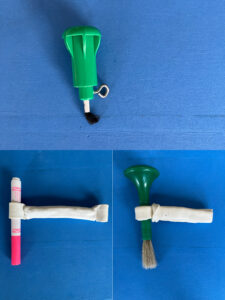
Early concepts to help a girl paint
A Girl Who Wanted to Paint
In 1984, Linda Merry moved to Elmhurst and began her career as an occupational therapist at Easterseals DuPage in Villa Park, working with children with disabilities. One day, a young client who could not hold a paintbrush, but could grasp a peg, told her she wanted to paint.
Linda took the peg home to her husband, Bob, who drilled a horizontal hole through its base, cut the top off a paintbrush, and secured the two with a thumbscrew. The next day, the girl painted on his own for the first time.
That small act of problem-solving sparked something bigger. Soon Linda was adapting handles for markers, pencils, glue sticks, and anything else that would let a child join in alongside their peers. Families began asking for a set for home, then school, then church.
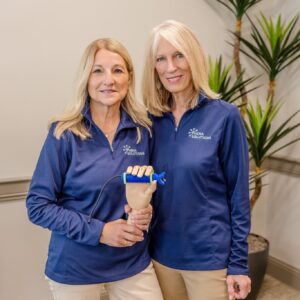
Inventors: Celine and Linda
Two Therapists, One Calling
In 1985, physical therapist Celine Skertich joined Easterseals DuPage and brought her own expertise to the growing effort. “I loved the sciences, knew I had a passion for working with kids of all abilities, and wanted to combine these interests,” Celine said. Watching children make functional gains while having fun during a college summer job in an aquatic therapy program, she knew she had found her fit.
Linda felt the same pull toward the work. “I was drawn to occupational therapy because it combined my interests in psychology, exercise, and working with families,” she said. “I wanted a career where I could make a difference and help people reach their potential.”
But every solution the two of them built only fit the child it was made for: a new mold for a new grasp, a new size, a new activity. After more than thirty years of watching that pattern repeat, Celine and Linda started wondering what it would take to build something that could do for a thousand kids what a peg and a paintbrush had done for one.
Innovation Runs in the Family
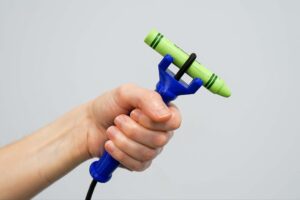
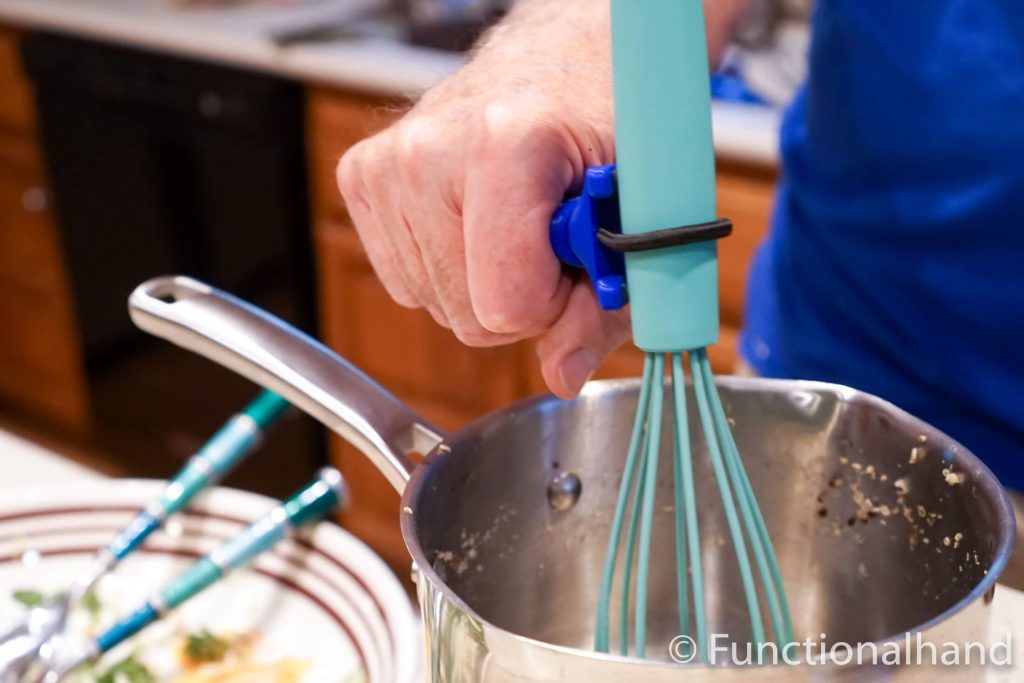
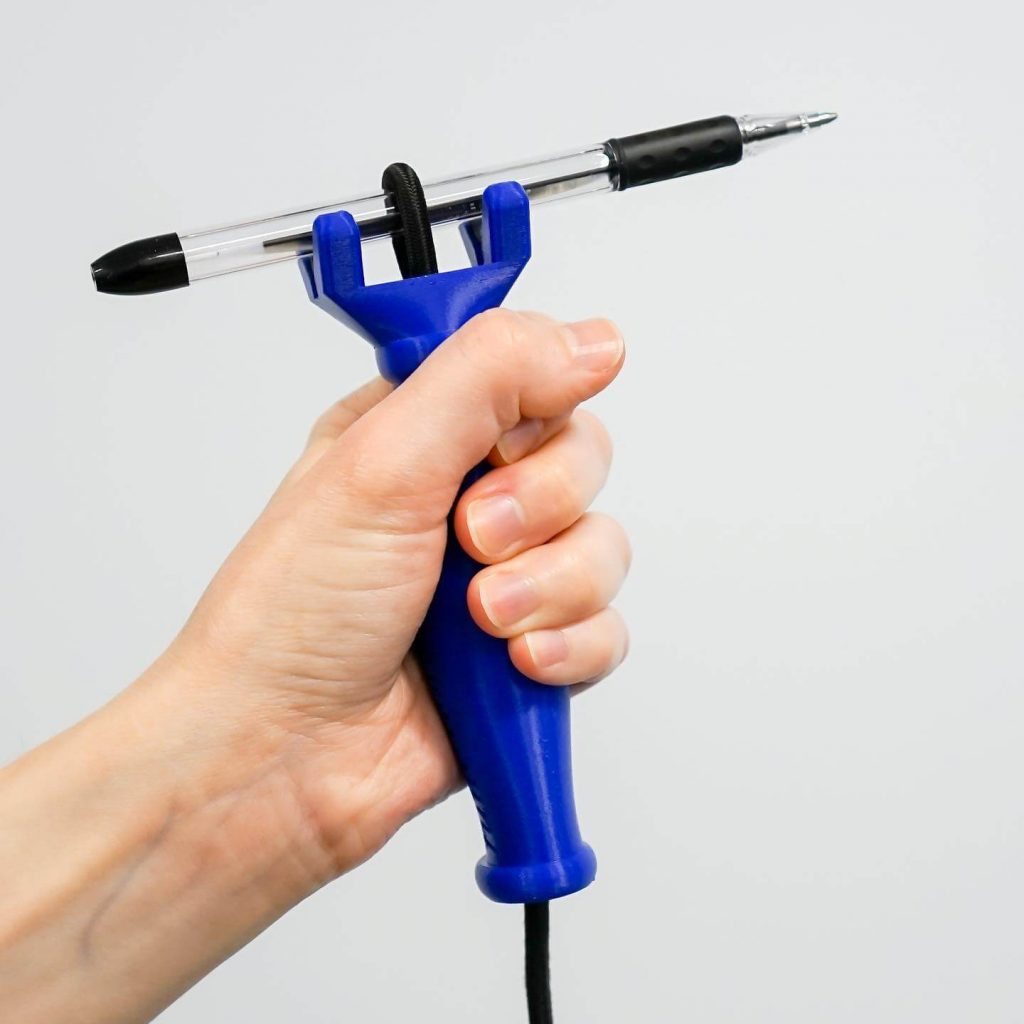
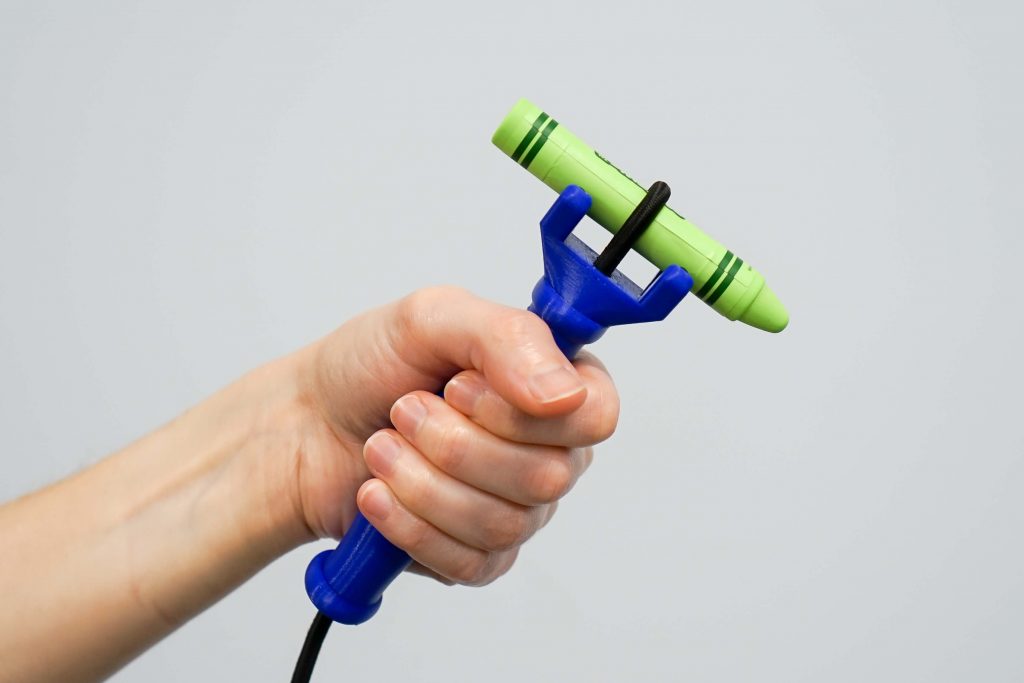
Patented design of the functionalhand®
In 2018, they founded Thera-Solutions, LLC, and set out to build a single adaptive device that could hold almost anything, from a pencil to a phone, without a new mold every time. True to how the whole idea started, at Linda’s own kitchen table with her husband, Bob, they turned to family to help build it.
Celine’s brother-in-law was first to lend a hand, working with them on an early circular handle. This prototype failed because it did not secure items firmly enough in the handle, but it pointed them toward the shape they were really after.
The real breakthrough came from Ted Corlett Sr., an 88-year-old retired engineer from Elmhurst who is also the grandfather-in-law of Celine's son, Nicholas. Ted had never touched CAD software or a 3D printer before. He spent a week teaching himself both, then reimagined the prototype and printed the very first functionalhand® at the Elmhurst Public Library.
Even their own kids played a part. Linda’s and Celine’s children were students at the University of Illinois at Urbana-Champaign, and that family connection led them to the Illinois MakerLab, the university’s 3D printing lab. By 2020, the MakerLab was producing the functionalhand® and shipping it out from Elmhurst.
From a provisional patent to being awarded a utility patent in February 2023, what began as a fix for one child, with help from a husband, a brother-in-law, a grandfather-in-law, and even their own kids, had become a product families and therapists everywhere could use.
From One Child to a Global Impact
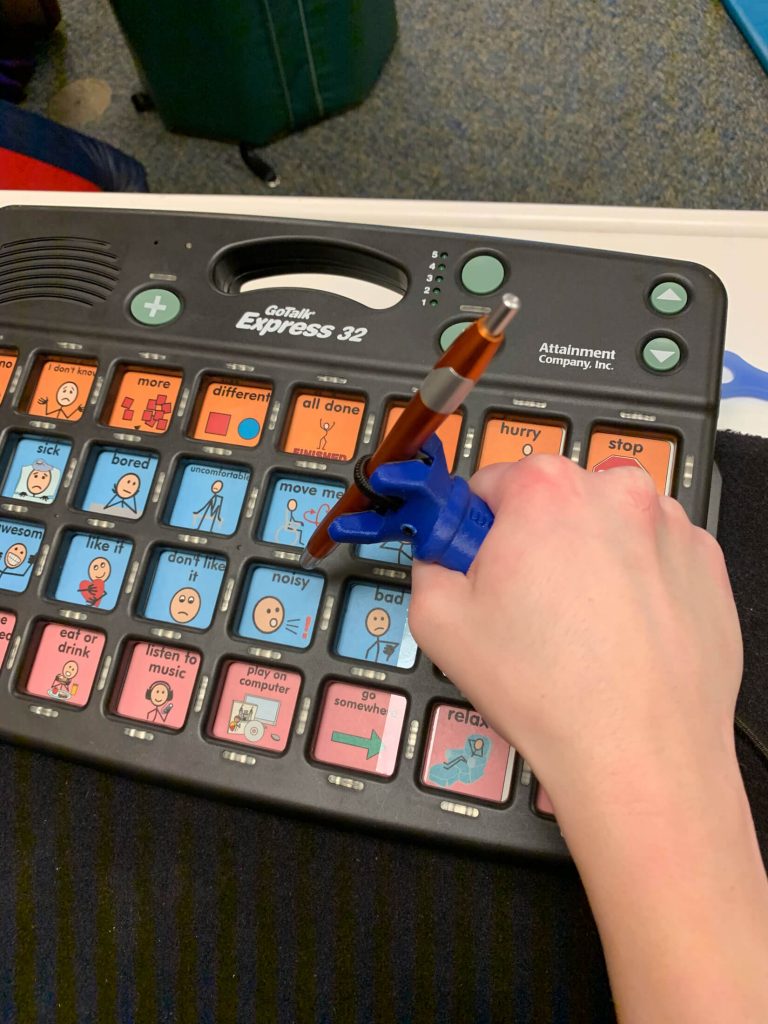
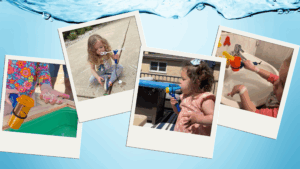
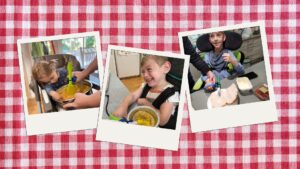
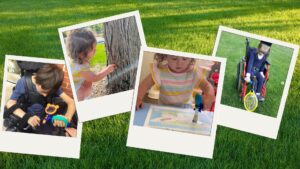
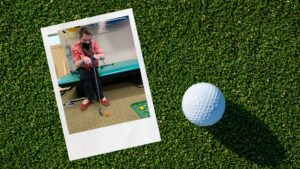
Today, the functionalhand® reaches homes, classrooms, and clinics well beyond Elmhurst. “When we get pictures from around the world, kids playing the violin, drawing, painting their nails, or using a computer, it’s incredible,” Celine said. “Seeing them do what they love with their families is the coolest part of this whole journey.”
“My favorite day is when someone emails me saying, ‘I’m trying to use this but need help,’ and then we problem-solve together until it works,” Linda said. “They can do something they did not think was possible. That’s when everything is worth it.”
Neither of them set out to run a company. They set out to help one child hold onto something that mattered. “If two middle-aged pediatric therapists with no business background can start a company, patent a product, launch a web store, and weather a pandemic, then you can too,” Celine said. “Our dream was to make sure every child could participate in the activities they love. That dream became the functionalhand®.”
Product Reviews